From otherworldly adventures, to intimate examinations of life’s most ordinary yet memorable moments and challenges, the top MVs of 2025 offered visual innovation, strong storytelling, and an emotional punch. Our writers Sabrina and Siena discuss!
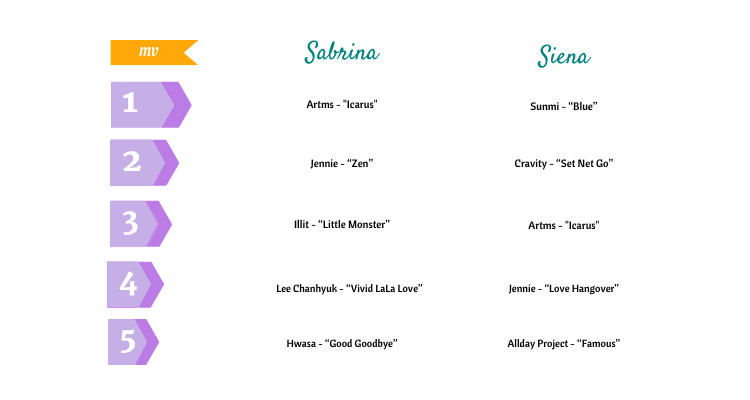
Siena: I hadn’t kept up with MVs this year, but bingeing them for this conversation, I was delighted to find lots to love. I do think I’ve hit a K-pop MV saturation point where most concepts feel familiar (though not always, as we’ll get into!). Therefore, I gravitated towards exceptional execution for my picks. Sabrina, what drove your choices?
Sabrina: Execution was an important factor to me too, though there were a number of technically well-executed MVs this year that didn’t hold my attention. My picks were the ones that did invite multiple viewings. I kept returning to these MVs because of their striking imagery, creative directorial choices, and overall emotional impact. I also appreciate when MVs convey something distinct about the artist.
I was pleased to see that we selected very different Jennie MVs for our lists, as they show her versatility and ambition. Appearing initially as an intro to her album Ruby, “Zen” was a powerful preview to her bold vision for her solo work. Jennie’s music has often projected self-confidence, but here she appears goddess-like, wearing headdresses and wings. The lyrics focus on developing inner strength, but the sweeping camera movements and skillfully timed montage sequences make this personal journey feel epic.
The more I watch “Zen”, the more layers I uncover. “Zen” is full of Korean historical references and Buddhist symbols that contribute to its depth. Her gold costume, for example, evokes a crown of female leaders from the Silla dynasty, combining individual confidence with cultural pride. Meanwhile, Jennie arises from a blooming lotus, a flower that grows in mud, representing resilience. However, one doesn’t need to analyze symbolism to feel intuitively how Jennie’s personal power grew from handling adversity. That speaks to how effectively “Zen” is constructed.
Siena, what led you to choose “Love Hangover”?
Siena: Jennie’s numerous MVs this year were indeed top-notch, and showed great range. What drew me to “Love Hangover” was its gleeful, detail-oriented execution that elevated a familiar concept… a funny thing to say about a darkly comedic doomed romance that sees Jennie die over and over in increasingly absurd ways in front of her bewildered and dismayed partner. But in a world with Red Velvet and a plethora of popular slasher comedies, it’s not a new story!
The MV is shot like a series of fully-realized mini movies and paced like a caper. I also loved the touches of animation throughout which resulted in some genuinely arresting images, such as Jennie’s animated self facing off against a Godzilla bursting through a drive-through movie screen. Additional kudos to Jennie’s acting, which is full of cheeky energy and good comedic timing, not to mention playful chemistry with her delightful co-star Charles Melton.
Besides its stellar execution, “Love Hangover” is a wonderful visual manifestation of the song itself. As Jennie sings about constantly circling back to a toxic relationship, on screen, she good-naturedly hands herself over to her (mortally) bad luck, whether being taken out by a flung olive in a restaurant, or floating into the stratosphere via carnival balloon. “Love Hangover” perfectly and entertainingly brings to life the wry wit of its song without resorting to a copy-paste storyline.
Like Jennie, Lee Chanhyuk had multiple excellent MVs this year. What made “Vivid LaLa Love” your fourth pick?
Sabrina: When “Vivid LaLa Love” first came out, I didn’t know how to make sense of it. But I immediately loved its eccentric cast of characters, retro styling, and fantastical touches, like singing plates and frogs. Like much of Chanhyuk’s work, the MV is entertainingly weird.
At the same time, I observed a feeling of emptiness at the core of “Vivid LaLa Love.” Showing Chanhyuk and a group of partygoers reveling in a mansion, the MV depicts people in a decadent world without love. While they consume everything at a feast (even plates!), they feel no real satisfaction. One scene with Chanhyuk dancing with a giant stuffed doll particularly underscores his isolation after the party ends.
The MV’s tone management, a key element of directing, particularly impresses me. Throughout the MV, Chanhyuk mindlessly twirls a gun in his hand, giving the MV a menacing undercurrent. However, until its conclusion, the MV never feels overly dark or dour. “Vivid LaLa Love” skillfully balances its nihilism with quirky dance sequences, compelling surreal images, and the song’s upbeat synthwave sound. Chanhyuk not only has a clear vision for his concept, but also its execution.
Sunmi is another soloist with a distinct concept in each of her MVs. I’d love to hear about your number one pick, “Blue.”
Siena: As a veteran of New York City apartment-living, I never thought there’d come a day I was rooting for a cockroach. But Sunmi’s “Blue,” an off-kilter love story between Sunmi and an incredibly endearing cockroach played by model Koki Kutsuna, made me do just that.
Beautifully shot, “Blue” is both laugh-out-loud funny (Sunmi having to use her full body weight to flip her boyfriend, who has assumed the “dead bug” position mid-picnic date, always gets me) and achingly poignant. The MV casts a soft but lasting spell, a surreal modern fable you can’t help but mull over in your head, trying to unravel the moral of the story.
Is Sunmi’s boyfriend a cockroach because he’s a deadbeat manchild? Or is he a cockroach because others look down on him, probably for one of the millions of reasons society finds to be awful just cause? “Blue” is simultaneously sharp enough and sweet enough to invite both interpretations… and to reject either as a definitive answer.
I loved “Blue” from first-watch, but even I was surprised as it slowly but surely climbed the ranks during my list selection-process. Ultimately, though, “Blue” was the 2025 MV that made me feel the most, lingering in my heart and head long after the bittersweet credits rolled.
Sabrina, you have a very different love story in your fifth spot… and one I’m delighted to see since it just barely missed my own picks! What made Hwasa’s “Good Goodbye” one of your top MVs of 2025?
Sabrina: “Good Goodbye” stood out for its beautifully bittersweet portrayal of a breakup. Each time I watch, I genuinely feel invested in both the love story and its end, which is a testament to Hwasa and Park Jeong-min’s individual acting abilities and chemistry as a pair. Watching them dance together or cuddle on a couch… it’s rare to see an MV with such realistic casual intimacy.
I also love that the MV portrays the couple’s romantic moments while also subtly illustrating the relationship’s end. Some shots are grainy and damaged like old film, indicating that Hwasa is recalling memories. Other images, like scraped skin, empty glasses, strewn luggage, or a facade of a dollhouse washed in the ocean, suggest the disintegration of the relationship. Together, the acting and visual imagery evoke the poignancy of needing to say goodbye to someone you deeply loved.
In my opinion, my picks also reveal the artists at their best. I’m thrilled that “Good Goodbye” has become a hit for Hwasa, because she really excels at mature, emotionally honest concepts like this.
Cravity have also released some of their best work this year. Tell me more of your thoughts about “Set Net Go.”
Siena: I love an ambitious story-driven MV, and I also love a bombastic performance-focused MV. I have exemplars of both among my picks! But ultimately, I think an in-between approach takes best advantage of what the MV has to offer as a medium. It’s a rare style, but one Cravity nail in “Set Net Go.”
The MV perfectly combines a clear aesthetic vision, strong performance sequences, and just enough story to compel viewers without burying them under mountains of lore. Trapped in an idyllic but eerie landscape, Cravity run through endless loops (of time, space, and symbolism), making slow progress towards freedom, or at least a moment of truth. It’s an intriguing concept, pulling on familiar tropes to create an artful, sun-kissed dystopia. Beautiful camerawork (several cinematic longshots in the MV’s closing moments hit hard every time) and committed performances are the cherry on top of this little slice of MV perfection.
Illit are also putting a spin on classic archetypes in your third pick. What about “Little Monster” shined for you?
Sabrina: “Little Monster” seemingly expresses a simple message: “Remember the magic inside you.” Like a fairy tale, though, the MV deftly uses magical concepts to process inner conflicts. Illit must handle “monsters” like anxiety and stress, which playfully appear as gummy bears that the Illit members devour. I appreciate that people in bright costumes also play the monsters, making life’s stressors our companions to befriend, rather than villains. It was moving to see the members smile after swallowing the monsters, break free from the tiny rooms that confine them, and float in the sky like superheroes, holding the magic wands that were in a garbage truck in the opening scene. The MV shows the wisdom of approaching adult problems with childlike wonder.
“Little Monster” is also exceptionally creative and well-crafted. As the industry increasingly embraces AI, I find it refreshing when MVs rely heavily on practical effects. I love the MV’s handmade aesthetic, particularly the intertitles resembling embroidery and the intricately detailed, diorama-like rooms. Illit’s team created this whole whimsical world through miniature sets, puppets, costumes, and props. With its good old-fashioned production design, “Little Monster” reinforces its message by flexing the imagination that we too often lose in adulthood.
Allday Project take a very different approach, with an MV produced by Rigend Film, known for their dynamic editing. I don’t gravitate to their style, but “Famous” certainly leaves a strong impression. What made it your fifth pick?
Siena: Rigend Film are maximalist cranked up to infinity: their MVs tow the line between chaos and intricacy, and not all find balance. But when they do (like Aespa’s “Armageddon” or Seventeen’s “Hot”), it’s a blast, and “Famous” is Rigend at their most bombastic and playful. Every opportunity for a creative transition is gleefully seized, sending viewers careening through glass, tunnels, elevator shafts, wheels, and in one so-crazy-it-works moment, a high heel that transforms into a night-time cityscape.
The biggest (fair) criticism of “Famous” is that this is not a classy party. This is fast cars, tall buildings, and shiny jewelry. It’s hard not to wonder what Rigend could achieve if they turned their eye toward something with substance. However, the MV’s shallowness is part of its charm. Rigend’s exacting approach could easily veer into the neurotic, wound tight in an impressive but not terribly fun way. But “Famous” is too silly to be neurotic. Instead, the MV is a low-stakes playground that a bunch of unhinged video editors have been unleashed on with the sole directive of “Have fun.” And I think that’s kind of wonderful!
“Famous” also impressed me because the MV is hard-carrying this debut. The song itself has a catchy chorus but that’s about it. As for the group…many thoughts (namely, what in the cultural appropriation is going on with Tarzzan), but the most relevant here is that they’ve struggled to consistently produce the stylish, confident energy that is central to their concept. “Famous” has no such issue. The MV accomplishes something pretty incredible by manufacturing aura and hype from the ground-up, and in such a memorable way that it is still propelling the group forward months later.
Switching gears, we come to our sole shared pick. “Icarus” from Artms is more like a short film than a traditional MV, packed with lore and some truly breathtaking images. There’s so much going right in both versions of the MV (a longer narrative-driven one, and then a shorter performance-focused one clipped from the long version). I want to highlight the brilliantly achieved mood of the whole project—part eldritch horror, part technological dystopia, and part coming-of-age drama—and the simple but astonishing editing work in the performance sequence that allows all five members of Artms to dance seamlessly as one.
I struggled with the pacing of the longer MV and also found some sequences more compelling than others, which is what brought the MV to third on my list. But there is no denying the incredible ambition (and incredible achievement) of “Icarus,” and it’s a joy to have audacious projects like this as part of the Hallyu scene. Sabrina, what made “Icarus” your top pick?
Sabrina: It IS impossible to deny the ambition of “Icarus,” so much so that it was difficult for me to imagine any other MV in the top spot. In addition to your observations about its imagery, mood, and editing, I was impressed by its handling of disparate story elements. I am usually indifferent to lore, but have missed its rich storytelling in recent years. “Icarus” has much to offer fans of Loona and Artms’ previous MV’s “Birth” and “Virtual Angel” by referring to images, characters, and storylines from earlier lore.
Yet I would argue that the MV works well without that knowledge, especially when letting go of the impulse to construct a linear story and just experiencing it. Directors Digipedi connect scenes with wing and crossbow imagery, giving the MV an intriguing associative logic. “Icarus” juxtaposes lore, mythological references, and cybercore aesthetics to evoke a journey of resilience and rebirth.
I also want to shout out the choreography-driven “club version,” as its expressionistic contemporary dance beautifully illustrates the song’s phoenix imagery. The MV is a masterclass not only in editing, but also blocking to create the illusion of members morphing into one another, before emerging in a wing-like formation as five. While it stands out most for its complex storytelling, “Icarus” also demonstrates the power of a dance sequence to convey an MV’s themes.

In fact, if I had more spots on my list, I would have picked something performance-driven, like Yeonjun’s bold triptych “No Labels Part 1” or Hearts2Hearts’ cleverly edited “Focus.” I also considered choosing an unserious MV, such as Close Your Eyes’ horror comedy “Snowy Summer” or Katseye’s over-the-top telenovela spoof “Gabriela.” Other runners-up include Miyeon’s dark, theatrical “Reno” and Yves’ haunting “Ex Machina.”
Siena, what were your honorable mentions?

Siena: I definitely second “Snowy Summer” and “Gabriela:” 2025 was a wonderful year for comic MVs! Chaeyoung also had multiple intriguing MVs that communicated her distinct vision as a soloist. But my biggest honorable mention goes to IU ft. Balming Tiger’s “A Beautiful Person,” with its quirkily charming narrative, sly references to real-world celebrity culture, and surprisingly sharp commentary on society’s obsession with looks.
Our plethora of honorable mentions, and this whole conversation, attests to 2025’s strong MV output. Here’s hoping that trend continues in 2026!
(Instagram, YouTube[1][2][3][4][5][6][7][8][9][10][11][12][13][14][15][16]. Images via Edam, Modhaus, Uncore.)