
Socio-Cultural
iu

IU Reaches out to Korea’s Bullied Teens

5

Often, you see stories of idols “giving something back” to their fans, be it making noodles, giving away free tickets or holding charity events. However occasionally you see a story that touches you personally, and this week I just so happened to stumble upon one such story that involves South Korea’s Sweetheart, IU, who has been recently made an ambassador against school violence.

While I wouldn’t call myself a die-hard fan of IU, I do like her music and can appreciate her wholesome and friendly image, and I believe that they made a good choice in selecting her to be ambassador. Sweet she may be, having made such a name for herself at such a young age must have required some seriously strong will. It is often said in show-business you need a thick skin, but I think that in fact the opposite is true. Especially in a culture that has a Confucian set of behavioral guidelines, everyone has a heightened need to be aware of others’ feelings and show respect to everyone. I think that is something that IU does well, and should be commended for.

Although they picked the right girl, I admit there are a few others I might have chosen — I bet G-Dragon and Seohyun would be great choices too. But mostly it just warms my heart to see a young person with such influence using it well. I’m no expert on bullying in Korea, but the huge pressure on young people to achieve academic success and look good can mean they take their frustration out on each other.
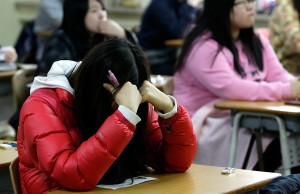
Yes, Korea may be top in terms of exam results worldwide, but take a look at some darker statistics and you’ll see how high the price is for that title. Korean students often study 6 days a week, attend cram school and private tutors, all for a few results they are told will make or break the rest of their lives. I feel uncomfortable criticizing an entire educational system, but with Korea also holding one of the highest teen suicide rates in the world, and children so stressed they would rather kill themselves instead of take the pressure of an exam, maybe it’s time something changed. Dr. Bae Joo-mi, a specialist at the Korea Youth Counseling Institute said of Korean secondary schools,

“At school, students don’t see their peers as friends but as competition and believe that they need to beat others.”

I’m of course aware that these are extreme cases and no country has zero-bullying. But while I am lucky enough to be growing up in a supportive and friendly environment where violence is virtually non-existent I have seen what schoolchildren can do. Korea has been accused of covering up cases of extreme bullying, but a recent surge in suicide among young people has meant new measures are being taken, and I really hope that IU can use her celebrity status to help that. She says in her statement that she has gone through trouble at school herself, and hopes she can “serve as a bridge between the police and schools, making sure that students study in a safe and fun environment.”

I wish her, and all the people involved luck in such a worthwhile project. It’s easy to be distracted by the glitter of K-pop, to forget that the majority of the people it is being made for live under a constant cloud of stress. I cannot commend IU highly enough for getting involved, and may we see some brighter statistics soon.

(CNNKeely Kernan)

Related Posts

  • Anon

    giggling because of the wings behind IU’s head

    • http://www.facebook.com/people/Anngelica-Aguilar/100000185514336 Anngelica Aguilar

      *gasp!!* It’s a sign!!!!! :O
      LOL!!

  • www.chaojishop.com

    帮博主顶一下。

  • http://www.facebook.com/people/Anngelica-Aguilar/100000185514336 Anngelica Aguilar

    They go into detail on bullying on eatyourkimchi. this is their article on it although I would also recommend watching their video because they cover stuff that’s not on here. :
    Anyhow, on with the show: we’re getting a lot of serious topics this month for our TL;DRs and today is no exception. Today’s question is from eaguyao001 from San Diego, California who asks,“have you seen bullying as bad as they make it out to be in Korea? And if so, what do teachers normally do about it?”Now we weren’t too clear on who this “they make it out to be” actually refers too, so we just assumed it meant Korean media, such as dramas, movies, and comics, aka “manhwa” 만화 in Korean or “manga” in Japanese. It’s true that any avid watcher/reader of Korean or Japanese drama and comics – such as myself, Martina – will know that high school life is a very, very common theme, and within this theme of school often comes the topic of bullying. Now we all know bullying exists in all parts of the world and at all age levels, so is bullying different in Korea, and if so, how?Well the idea of bullying being “bad” in Korea, suggests that maybe it’s not as bad somewhere else, and frankly, we don’t think it’s possible to say one countries bullying is worst than the other, because bullying is equally terribly everywhere. So I don’t think that was the intention of the question (was it?). We’re thinking that the question was asking whether bullying is as prevalent in South Korean schools as it is in its depictions, which we really can’t answer. We taught at one school each, and our schools were in no way the norm. So the most we can talk about here is what we noticed in bullying in South Korea.Our main point of interest deals with the school environment itself. We feel like Japan and Korea are similar in this way since both countries have ridiculously long school hours (7am – 11pm or later, Monday – Saturday) and in turn, the classroom becomes a second home. Students pretty much live at school; they brush their teeth after each meal, change into slipper shoes, personalize their desk with colourful seat cushions, pencil holders, and bring pillows to sleep on.This is very different from how we experienced high school, both as high school students, and as former high school teachers in Canada. Since you moved classes between every subject, your desk was just an impersonal place to sit and be used by the next student. Our lockers were the only personal part of our high school career, and those were locked up tightly and often decorated with photos of friends and/or stuff we liked.Korean students, on the other hand, have a single homeroom class that they stay in for the whole year. It’s the teachers that move between the classrooms. The students might leave that classroom once or twice a week to visit, for example, the Foreign English teacher’s classroom or the music room, but most classes are taught in their homeroom class. They also have little shoebox sized lockers, but they are located inside their homeroom classroom and many students don’t even bother to lock them. This environment creates a very important difference between how bullying occurs in North America and Korea. An attack by a bully in Korea can be aimed not just at you as a student, but also at all the stuff you deem important, the stuff you use to make you feel happier in your second home, the second home you study in for 16 hours, with the same students for the whole year. If you are being bullied by a classmate, there is no escape from them since you have to see them all day everyday. We’ve heard cases of shoes being vandalized, tacks hiding under seat cushions, or insults scribbled on desks.We have heard stories from our Korean co-workers of students secretly fighting and bullying others in the washroom or outside the classroom for money or food, but personally, we’ve never seen that at our former schools. Possibly because we were at very good schools that were very focused on grades and studying, possibly also because our experiences with the students were a bit limited, since we had to teach around 22 different classes per week or so. However, even if you’re at a school that caters to students who are super duper focused on grades, there are forms of silent bullying that we actually have experienced, such as certain students being made 왕따 (wang-dda) which basically means they are made a social outcast and completely ignored by EVERYONE. Even if you don’t personally have a problem with this person, interacting with them will make you a wangdda and then you too will be isolated. In turn, students feel that it’s best to just ignore them as well. This most frequently happens to students who don’t find a social circle to fit into right away. Even if you’re made wang-dda in 1st year highschool, it can continue throughout your whole three years in high school. We were told some students will move schools in an attempt to escape their wang-dda labelling. A wang-dda student can experience bullying from silent ignoring all the way up to physical fighting. It depends on the school and the type of bullies present.So what can teachers do to prevent this from happening? It seems like not much. When we talked to our Korean co-workers about it, they said that most students will just cast their eyes to the ground and not speak during their interrogation. Whole classrooms can be scolded for their bad behaviour but everyone just remains silent. Sometimes addressing the issue can make life worse for the bullied student, so many teachers feel like ignoring it is the best method. Just one of the big problems we see with Korean school system is that there are no guidance councillors available of any sort. There is no one for the students to confine in when they are stressed out or upset, and seeing a councillor or a psychologist outside of school just isn’t available and is really looked down upon

  • Black_Plague

    I believe the article is somewhat a bit under-informed, as I’m a Korean who also attended middle school and high school in Korea (senior in MS and freshman in HS, from 2008 to the end of 2009).

    At the city I lived, Icheon (not confused with Incheon), the schools were quite rather lackluster with their students – at the MS I went, most students hardly paid attention in class, others slept, some talked out loud about other things etc. behavior was quite lowly but for any 15yr old, it would have been a ‘fun’ experience. At my class in MS, out of 40 students (myself included), just 1/4, maybe even less, studied 6 days a week or had the typical cram school and tutoring lessons. Some families even provide such things for their children simply so they’re perceived as ‘normal’ and changing cram schools often is quite common. For the bullying, every grade had at least 2-3 students who were bullied – they frequently had their pocket money stolen, got beaten occasionally, verbally abused etc. – however, anyone that stands up for them are also automatically targetted as well and this is one of the reasons why bullying in Korea is a difficult issue to tackle (which further goes, the other kids treat the victim like an alien, myself having done the same thing, admittedly). This also goes to say, that even the average kids get somewhat bullied by the more rough kids – maybe not getting beaten up or being verbally abused like hell but having a portion of their money taken is common. As far as it goes, grades and such isn’t the most prominent reason why bullying is a serious issue in Korea.

    HS was entirely different, but that’s probably because I went to a vocational school with only what, 200 students? And 70% of them were from other cities (yes, a school with dormitories).  Bullying was almost non-existent, except for the freshmans – one guy was frequently subject to getting beaten and abused in a lot of ways (but at the same time, he wasn’t really much of a nice guy to get along with, in my opinion seeing as he was an awfully unreliable as a witness to get one particular bully expelled). Even though the bullying stopped, he was treated like an outsider.

    I don’t know about IU’s experiences in bullying but wouldn’t it be better if an idol who has gone through the actual experience a better choice? T-ara’s Soyeon actually confessed some weeks ago on TV that from elementary school to high school (or was it middle school?), she had been both a bully and a victim of it – which further goes, she has first-hand experience in it in detail as she didn’t debut until 2009, some years after graduating HS (while IU’s been around the music industry since she was 15 and she’s turning 19 this year).